Billings & Yellowstone County, Montana
Concrete Leveling & Mudjacking in Billings, Montana
Billings gets 14.3 inches of rain a year. So when a slab sinks here, the first question isn’t when — it’s where the water came from.
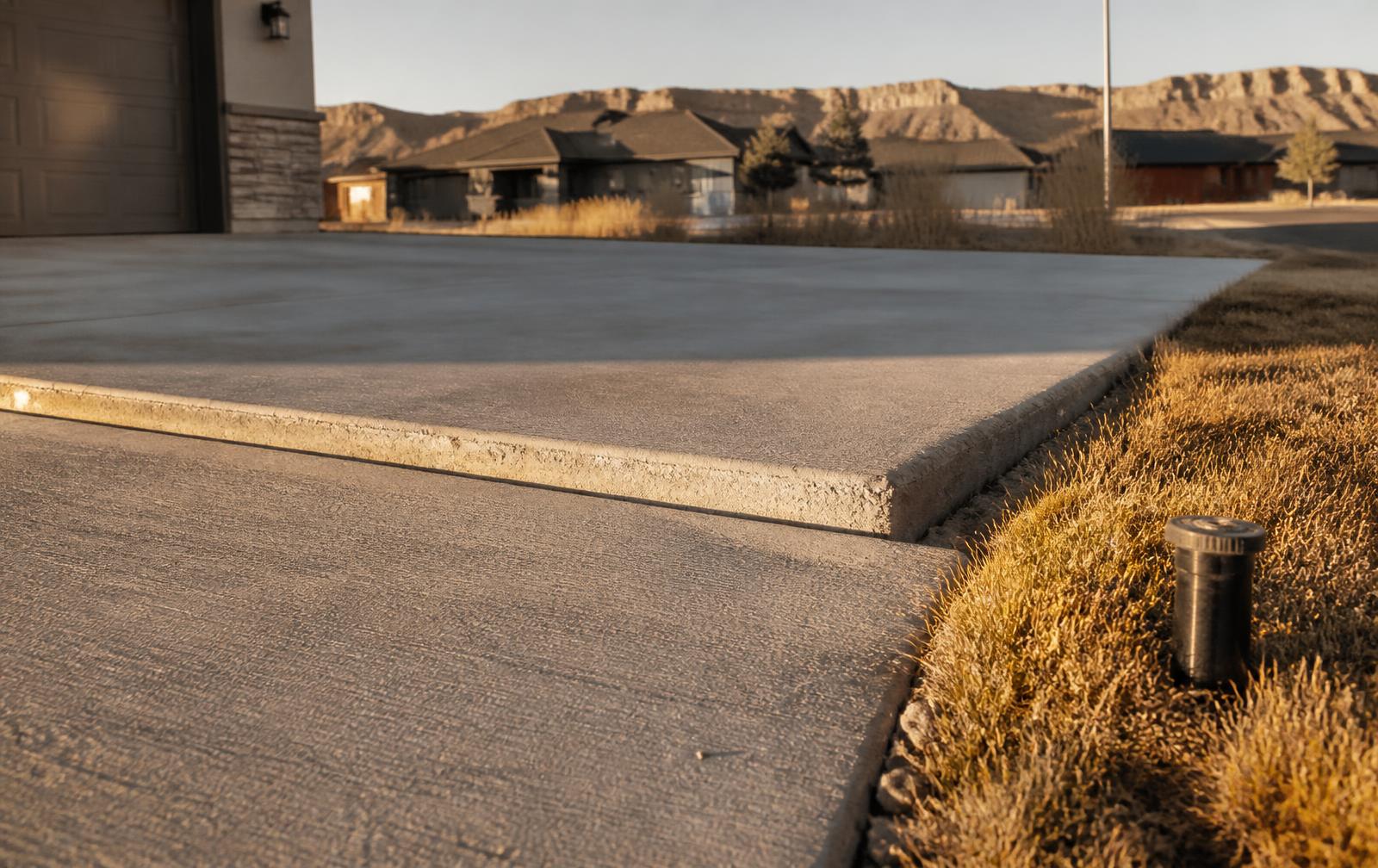
Start here
Find your water source
One of these is almost always the reason. Pick the one that sounds like your property.
A sprinkler zone runs along the slab edge.
The most common one. Repeated wetting on one side only, all summer.
A downspout dumps at a corner.
Concentrated volume in one spot, every storm.
A service line leaks, or a trench was backfilled.
Water follows the trench. Loose backfill settles for years.
The slab rises and falls with the seasons.
That's swelling clay, not a void — a different problem with a different fix.
It dropped fast after a wet stretch.
That points to washout and a cavity underneath.
The mechanism
Your slab is either being lifted or being undermined
Around Billings you are dealing with two soil behaviours, and they fail in opposite directions.
The expansive one.
The Bew series is classified by USDA as Fine, smectitic, frigid Torrertic Haplustalfs — 50 to 60 percent clay in the argillic horizon, dominantly smectite, with slow permeability. Smectite takes on water and swells, then shrinks as it dries. A slab over it moves seasonally. You will often notice a door that sticks in spring and clears in August, or a driveway panel that sits proud one year and flat the next.
The dispersive one.
Much of the valley alluvium here comes from marine shale. In dispersive clay, sodium dominates the pore water, so the clay particles repel each other instead of holding together. The NRCS puts it this way: individual colloidal particles ‘go into suspension in practically still water’ — where ordinary clay would need real current to erode. That soil does not swell. It leaves.
The second one is what puts a cavity under concrete. And a void is why a slab can look fine for years, then drop most of an inch in a single wet spring.
Semi-arid, still moving
Why 14 inches of rain doesn’t mean dry ground
Billings averages 14.3 inches of precipitation a year. In a climate like that, the water that actually moves soil under a driveway usually didn’t fall out of the sky. It came from a sprinkler zone, a downspout, or a line that leaks.
The Colorado Geological Survey lists the same causes for settlement in semi-arid ground — watering grass and shrubs, failing to repair leaking water lines in utility trenches, impounding water — and describes what happens underneath as binders that ‘break, soften, disperse, or dissolve’ once water is introduced to soil that has been dry a long time.
There is a practical consequence. If we lift your slab and the sprinkler zone that undermined it keeps running the same way, you have bought time rather than a fix. Part of any honest assessment here is finding the water and turning it off.
Method
Two methods, and they are not interchangeable
| Mudjacking | Polyurethane foam | |
|---|---|---|
| Injection hole | 1–2 inches | 5/8 inch |
| Back in service | 24–48 hours | about 15 minutes |
| Weight of fill | 100+ lb per cubic foot | 2–8 lb per cubic foot |
Figures from industry sources (HMI; Superior PolyLift), not our rates.
Weight is the part most people miss. If the soil under a slab failed partly because it could not carry load, adding a hundred pounds a cubic foot of wet slurry is worth thinking about. Foam weighs a fraction of that. Mudjacking still wins on very large voids where bulk fill is simply cheaper, on low-stakes yard pads, and where a slab is scheduled for replacement anyway and just needs to be safe until then.
Full cost ranges for this marketWork
What we lift
- DrivewaysSettled panels, lipped joints and the low corner where the downspout lands.
- Sidewalks & trip hazardsRaised or dropped edges along public walks, entries and side yards.
- Garage floorsSlabs that pulled away from the apron or slope back toward the house.
- Patios & pool decksPads that drain the wrong way after the soil beneath them moved.
- Steps & porchesStoops tilting toward the foundation and risers gone uneven.
- Void fillingFilling the cavity washed out under a slab before it cracks through.
Coverage
Where we work
The permit picture changes by jurisdiction. Billings and Laurel are incorporated cities with their own rules, while Lockwood and Shepherd are unincorporated and fall to Yellowstone County.
- Concrete leveling in Billings
Incorporated city with its own engineering and permit rules.
- Concrete leveling in Laurel
Incorporated city, separate public works department.
- Concrete leveling in Lockwood
Unincorporated — permits fall to Yellowstone County.
- Concrete leveling in Shepherd
Unincorporated — permits fall to Yellowstone County.
Questions
Three things people ask first
- Why does concrete sink?
- The slab is fine — the soil under it moved. Either it swelled and shrank with moisture, or it washed out and left nothing holding the concrete up.
- What is a void?
- An open cavity between the underside of the slab and the soil. It is why a driveway can look normal for years and then drop most of an inch in one wet spring.
- Do I need a permit to replace a sidewalk?
- It depends on the jurisdiction and whether the walk is in the public right-of-way. Billings and Laurel handle their own; Lockwood and Shepherd fall to Yellowstone County.
Not sure which of the two you have?
Describe what you’re seeing — seasonal movement, a sudden drop, a trip edge that keeps growing — and we’ll tell you whether you’re looking at swelling clay or a void, and what each one costs to fix. No obligation.